
Almost everyone agrees reviewing your trades is the highest-leverage habit in trading. Almost no one keeps doing it. The reason isn’t laziness — it’s that “review your trades” has no shape. Sit down with a month of trades and no structure, and you’ll stare, feel vaguely guilty, and close the tab.
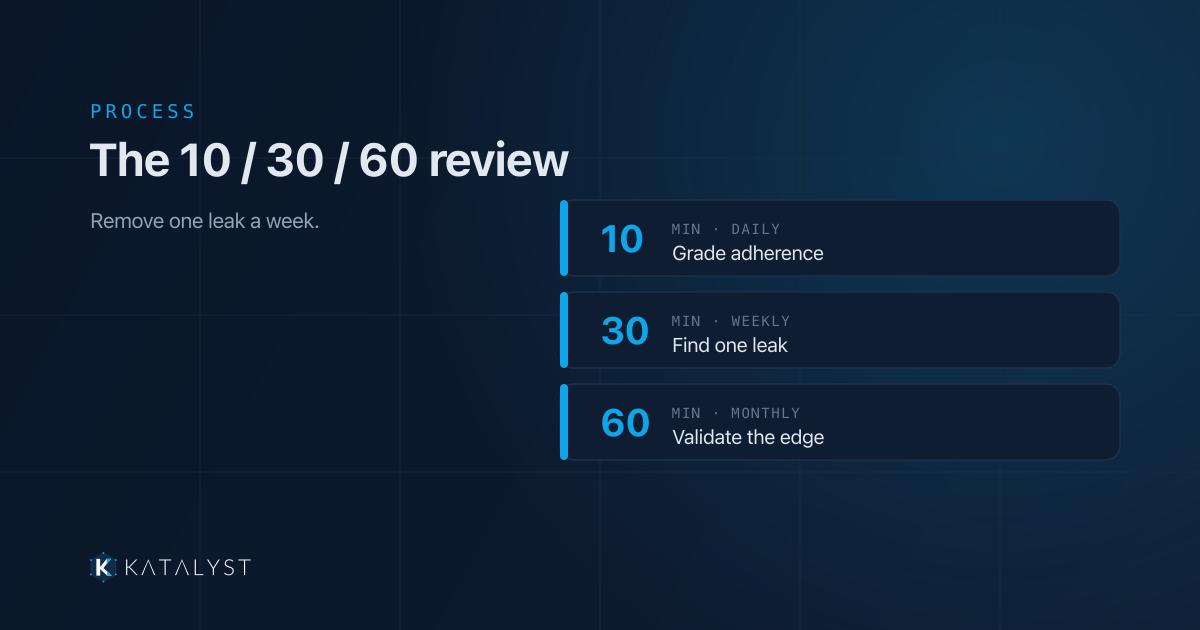
The fix is a review with tiers and time limits, so each session has a job small enough to finish. Call it the 10/30/60.
10 minutes: the daily grade
Right after the close, spend ten minutes doing one thing — grade each trade A/B/C for plan adherence, not for profit. A losing trade that followed your plan perfectly is an A. A winning trade you took off-plan is a C, because it’ll teach you the wrong lesson.
Add one line per trade on decision quality and emotional state. That’s it. Ten minutes, done while the why behind each entry is still fresh — not reconstructed on Sunday when the context is gone.
The one thing that reliably kills the daily habit is data entry. If you’re exporting fills and rebuilding round-turns every night, you’ll quit inside a month. With automatic Rithmic sync the trades are already in Katalyst when you sit down, so your ten minutes go to thinking, not typing.
30 minutes: the weekly leak hunt
On the weekend, spend thirty minutes finding one leak. Not five. One. The weekly review’s power is that it compounds — remove one leak a week and after a month your edge is measurably sharper:
- Week 1: You notice your lunch-hour trades lose money.
- Week 2: You stop trading lunch and save $300.
- Week 3: You find your FOMO-tagged trades win 28% of the time.
- Week 4: You add a rule — no FOMO entries.
Two views do most of the work here. Run a time-of-day breakdown in the seasonality view — most day traders have two or three genuinely profitable hours and don’t know which ones. And slice your trades by setup and tag in the pivot grid to find your single worst behavioral pattern.
Your biggest edge is usually hiding in your calendar, not your strategy. Cut the two losing hours you didn’t know you had and the equity curve changes shape.
60 minutes: the monthly strategy check
Once a month, go deeper for an hour. This is where you check the machine itself against expectations:
- Does your win rate, average reward, and drawdown match what your strategy is supposed to produce?
- Is your expectancy positive and stable, or drifting?
- Which setups earned a size-up, and which earned the bench?
The P&L analysis view and your equity curve carry this tier. You’re not looking at individual trades anymore — you’re asking whether the edge is still there and where it’s strongest.
Why the tiers matter
| Tier | Cadence | Time | Job |
|---|---|---|---|
| Daily | After the close | 10 min | Grade adherence, capture emotion |
| Weekly | Weekend | 30 min | Find and fix one leak |
| Monthly | Month-end | 60 min | Validate the strategy |
Each tier answers a different question at a different altitude. The daily grade keeps the data honest and complete. The weekly hunt turns that data into fixes. The monthly check makes sure you’re still trading a real edge. Skip the daily tier and the other two run on garbage; skip the weekly and you collect data you never act on.
For this to work at all, the review has to be built on every trade — winners, losers, and the scalps you’d rather not log. Automated sync guarantees that completeness; manual journaling quietly biases your stats toward your best behavior, and you end up reviewing a flattering fiction. (More on why that matters in why a trading journal is the highest-ROI habit.)
Start small, keep it forever
Don’t try to run all three tiers this week. Start with the ten-minute daily grade and do only that until it’s automatic. Add the weekly leak hunt once the daily habit sticks. The monthly check follows on its own.
Connect your account to Katalyst, let it keep your journal current, and give your review the shape that finally makes it a habit you keep.