
Ask a room of futures traders what wrecks accounts and they’ll name strategies, indicators, market conditions. The real answer is quieter and more consistent: revenge trading. It’s the most destructive habit in futures and also the most common — and the good news is that it leaves fingerprints all over your journal.
What revenge trading really is
Revenge trading is entering a new trade immediately after a loss, usually at larger-than-normal size, without meeting your setup criteria — driven by the need to win the money back or prove the original idea was right. It rarely feels like tilt in the moment. It feels like conviction.
The damage isn’t the single trade. It’s the cascade. One revenge trade sours the session, the bad session sours the week, and traders who audit their drawdowns discover something brutal: nearly all of the losses beyond normal variance came from post-loss revenge periods. The variance you can survive. The revenge is what compounds into a blown account.
Its close cousin is overtrading — taking more trades than your strategy justifies, out of boredom or the belief that more trades equals more profit. Both share one tell: trades you can’t explain with a clear, pre-planned rationale.
The problem: you can’t feel it, but you can tag it
In the moment, a revenge trade is invisible to you — it’s wearing the costume of a good setup. The only way to catch it reliably is to make it visible after the fact, at volume, across dozens of trades where the pattern can’t hide.
That’s what tags are for. When you tag and organize your trades in Katalyst, you’re not just filing them — you’re building the dataset that exposes your habits. Tag each trade with context like:
post-loss— taken right after a losing traderevenge— entered to win money back, off-planfomo— chased an entry you didn’t plana-plus— a clean, pre-planned setup you’d take every time
Do this for a month and something clarifying happens. The trades you were embarrassed about stop being anecdotes and become a number.
Let the pivot grid do the accusing
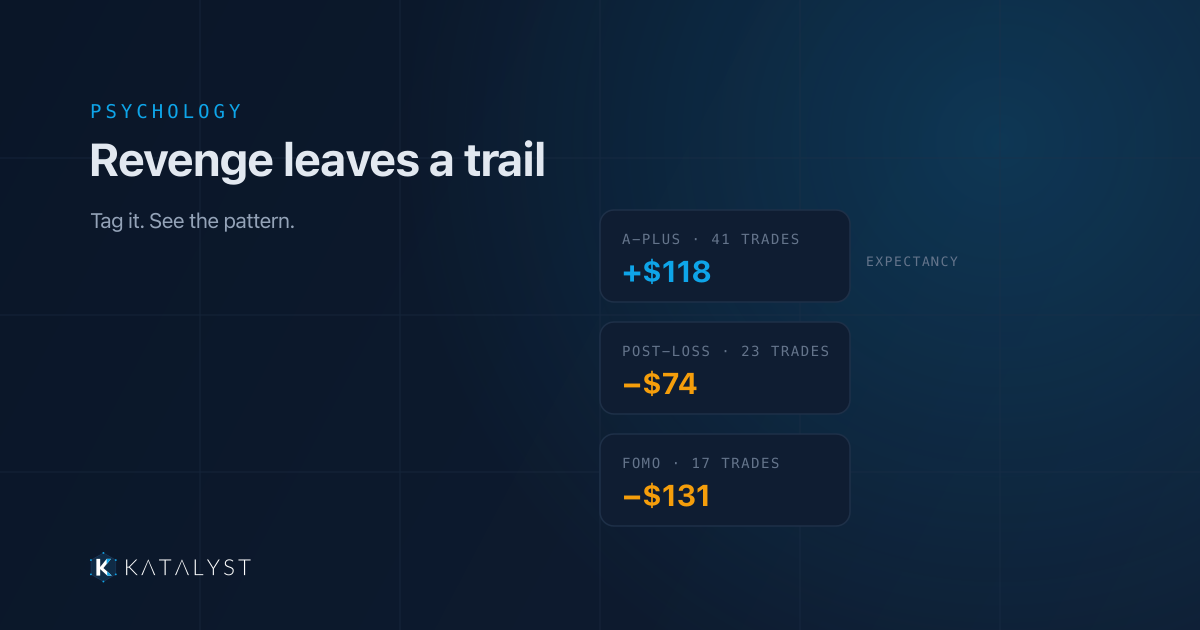
Individual tagged trades are memories. Aggregated, they’re evidence. Drop your tags into the pivot grid and look at expectancy per tag:
| Tag | Trades | Win rate | Expectancy |
|---|---|---|---|
a-plus | 41 | 58% | +$118 |
post-loss | 23 | 39% | −$74 |
fomo | 17 | 28% | −$131 |
The table above is illustrative, but the shape is almost universal: your planned setups carry the account and one or two emotional tags quietly bleed it. You don’t need willpower to see that — you need the breakdown. And because automatic Rithmic sync captures every fill (including the ugly ones you’d rather forget), the data isn’t biased toward your best behavior. Manual journaling skips the painful trades; automated sync doesn’t let you.
A revenge trade you can rationalize is a story. A
revengetag with −$131 expectancy across 17 trades is a fact. Facts change behavior; stories don’t.
One rule that stops the cascade
Awareness is step one. The fix is a mechanical circuit-breaker that doesn’t rely on you feeling calm:
The cooldown rule. After any loss beyond your normal risk, or after two losses in a row, step away for at least 30 minutes. Some traders shut it down for the day. The point is to put time between the loss and the next decision, because the cascade lives in that gap.
Pair it with a daily trade cap. If your strategy produces two quality setups a day, cap yourself at three. The cap makes overtrading structurally impossible instead of a matter of discipline.
And if a single loss feels devastating enough to trigger a revenge trade, that’s often a signal your risk per trade is too high. Size it down until one loss is a shrug, not an event — model it with the risk/reward simulator.
Make the invisible habit visible
You will not out-discipline revenge trading in the moment; the moment is exactly when discipline is gone. What works is a system: tag every trade, review the tag breakdown weekly, and enforce a cooldown that runs whether or not you feel like it.
Start tagging in Katalyst, let the pivot grid show you the number, and turn your most expensive habit into your most obvious one.