
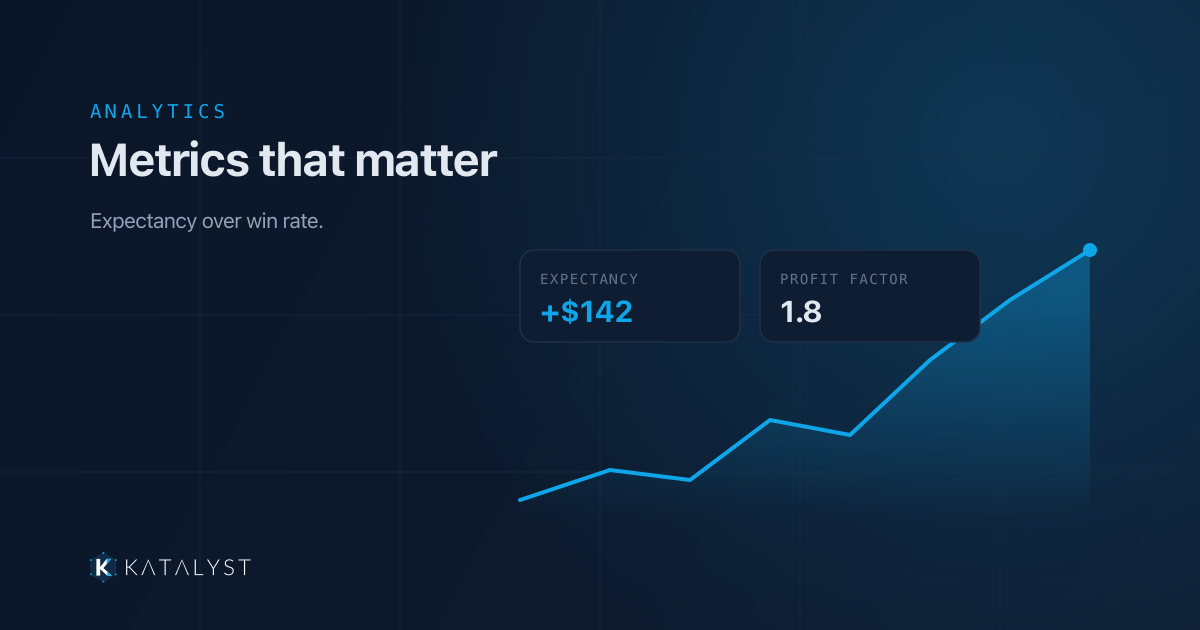
Ask a struggling trader about their performance and they’ll usually lead with win rate. “I’m right 60% of the time.” It sounds great. It also tells you almost nothing about whether they make money. Here are the numbers that do — and a few popular ones worth ignoring.
The metrics that matter
1. Expectancy
Expectancy is the average amount you can expect to win (or lose) per trade. It folds win rate and risk/reward into a single number:
Expectancy = (Win% × Avg Win) − (Loss% × Avg Loss)A 40% win rate with a 3:1 reward-to-risk ratio crushes a 70% win rate with a 1:2 ratio. Expectancy is the only metric that tells you, in dollars, whether your system has an edge.
2. Average win vs. average loss
The ratio between your average winner and average loser is where most edges are made or lost. If your average loss is bigger than your average win, you need an unusually high win rate just to break even. Most blown accounts trace back to this one imbalance: cutting winners early and letting losers run.
3. Maximum drawdown
Your biggest peak-to-trough decline tells you whether your strategy is survivable. A system with great average returns but a 50% drawdown will get abandoned — usually at the worst possible moment. Drawdown is a psychological metric as much as a financial one.
4. Profit factor
Profit factor is gross profit divided by gross loss. Above 1.0 means you’re net profitable; 1.5 and up is solid; above 2.0 is excellent and worth scrutinizing for sustainability. It’s a clean, single-number health check on a strategy.
5. Performance by setup
Aggregate metrics hide the truth. Break everything down by setup and the picture sharpens:
- Which setups carry your account?
- Which ones quietly bleed money?
- Should you size up the winners and cut the losers?
Katalyst’s pivot grid is built for exactly this — slice your trades by setup, instrument, time, or tag and see expectancy per bucket.
The metrics that don’t matter (much)
| Metric | Why it misleads |
|---|---|
| Win rate alone | Says nothing about risk/reward or expectancy |
| Total number of trades | Activity is not the same as edge |
| Single-day P&L | Too noisy to draw any conclusion from |
A high win rate feels good. Positive expectancy is good. Optimize for the second one.
Put it into practice
Pick two metrics to track this month: expectancy and average win vs. average loss. Review them weekly alongside your trades. If your expectancy is negative, no amount of trading more will fix it — the math has to work first.
Everything in Katalyst rolls these numbers up automatically, so the only thing you have to bring is the discipline to look at them honestly.